

New year – new luck
The new fertilization year started on February 1st – at least in theory. Fertilizer cannot simply be applied; there are separate regulations for this. For example, there is a general closed period for slurry from the harvest of the last main crop (usually from October) until January 31 of the following year. For manure it is similar, so in the end this means a storage period of at least 3 months – during which fresh manure naturally continues to accumulate.
Wet soils
BUT: In addition to the time restriction, there are further rules that depend on weather and soil conditions – and neither can be influenced. For example, the soil must not be frozen and there must be no standing water on the field.
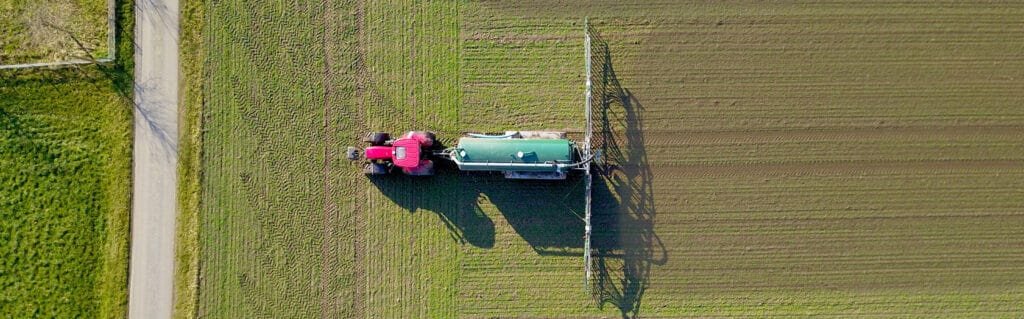
Most likely, frost will not be the problem in our region – but many fields are still far too wet. In addition to the ban, the large machines with full tanks or manure spreaders often cannot even get onto the fields, they are simply too heavy. Soil compaction is therefore inevitable, and this is not only a significant extra effort, but also damages the soil.
Time management
Another problem is the increasing amounts of manure and slurry. A farm must indeed be able to show sufficient suitable storage capacity. But there are always exceptions, and the calculation of storage capacity is also based on guideline values. In addition, longer-stored slurry must be stirred more intensively so that the formed floating and sinking layers become liquid again. However, this only makes sense shortly before application – otherwise they will settle again after some time.
There are therefore many variables, and when it finally starts, things often become stressful. The basic planning is done in advance, but then the slurry mixer also has to be available at the right time, because not every farm has its own. The same applies to suitable spreading technology.
Top tip
And this is where our lagoon comes into play. Those who already use it will in any case have less effort when stirring. But depending on how long the weather lasts, small improvements can still be achieved even now. And its use in manure can also be worthwhile: it decomposes much faster, and thus the volume decreases. So it requires less storage space. Of course, use over the entire storage period is better, but sometimes even small changes can help.