

Estimated reading time: 4 minutes
Buying silage wrap film is really simple: as long as it works and is cheap, that’s all that matters!
That’s what many people think—but is it true? Of course not!
Many users of wrapping film limit themselves, when purchasing, to information about thickness, width, and length—details that are often only stated on the packaging or in brochures. The assessment of film quality is usually limited to visual impression, personal experience, and trust in a brand or supplier. Not only has everyone become accustomed to this way of buying, but parts of the sales side actively take advantage of this customer behavior—using specially manufactured wrapping films to generate significantly higher profits while still appearing inexpensive.
How does that work? Quite simply—if you know how!
The biggest lever is the formulation of the plastic blend. The difference between absolute top quality and a very basic silage wrap film can be up to €1 per kilogram—that’s up to €25 per roll.
The second biggest lever is the thickness of the film, where 5–10% is often “saved.” That’s another €5–10.
Yes, you read that correctly! The difference between a top-quality silage wrap film and a price-optimized one can be as much as €35!
But don’t worry: to ensure the film still performs properly, the full “saving” potential is usually not exploited. In reality, on the European market, the difference tends to be around €15–20.
Buying silage wrap film – what really matters?
Of course, price plays an important role, and everyone decides for themselves whether to buy a cheap, basic silage wrap film or a somewhat more expensive top-quality product. It becomes frustrating when someone is promised top-quality goods based on trust but receives only a basic quality instead. The most important information should be available in writing, including any tolerances:
Thickness (μ), width (cm), and running length (m): This is already standard, though usually without any indication of tolerances.
Dart drop: Dart drop (puncture resistance in grams), together with the actual thickness value (in μ) of the film, is the best way to assess the quality of the plastics used—and therefore the quality of the silage wrap film. Depending on production conditions, manufacturers achieve very different values for silage wrap films.

What is the benefit of plastic quality?
The right composition (formulation) of different plastics and additives not only determines cost and puncture resistance but also has a decisive influence on tear strength and elasticity. Simply put: the higher the quality, the greater the reliability during wrapping and the safety during storage.
Who says these quality differences even exist?
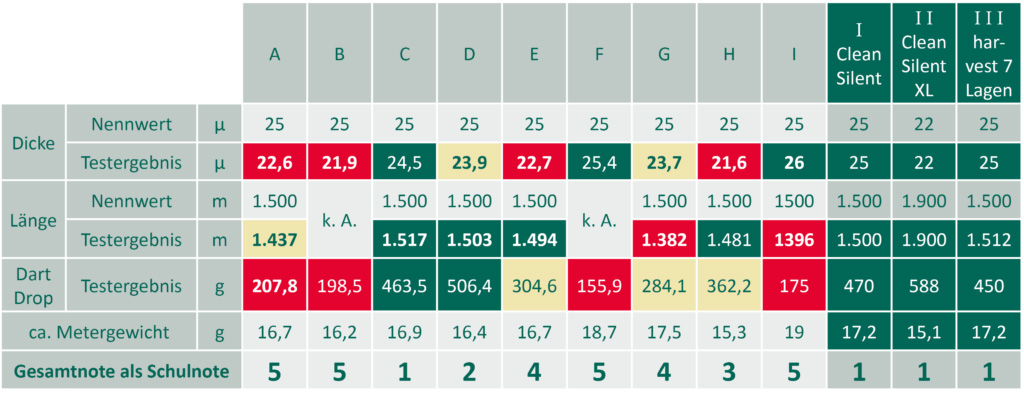
We at jbs do—not because we made it up, but because we investigated it together with our partners. To do this, we purchased many different silage wrap films from the market and had them tested in the lab according to standard parameters. To show as clearly as possible in a graphic how large the differences are, we evaluated the measurement data and converted it into a school grading system.
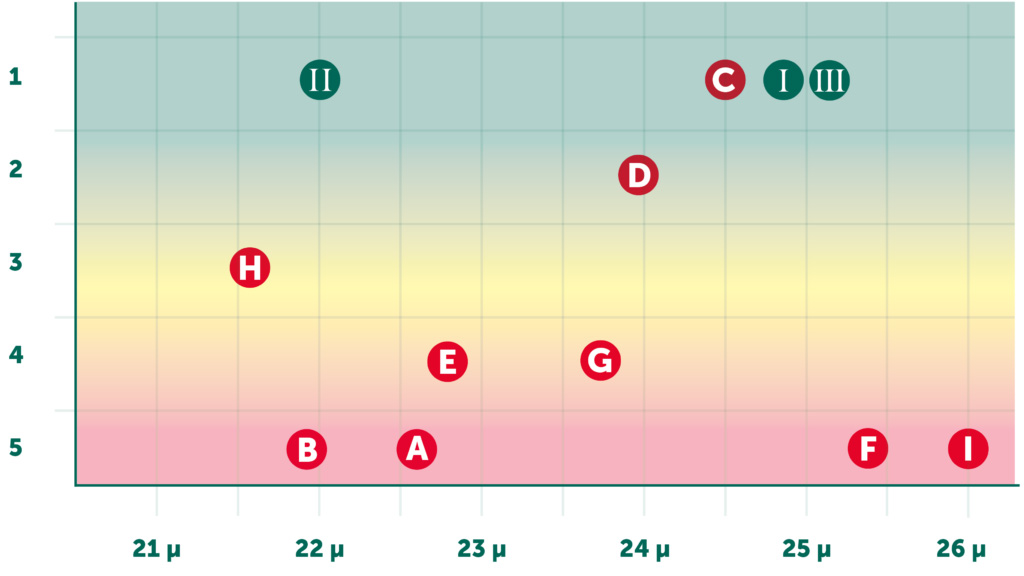
The weighting of the measured parameters refers to the highlighted parameters in the table below. Silage wrap films purchased by consumers (source: jbs).