

Estimated reading time: 3 minutes
Don’t feel like reading? Then simply listen to this article.
Chemical basics
Very briefly: nitrogen exists in the soil in different forms and is converted by soil organisms into nitrate and ammonium – which in turn can then be absorbed by plants. Nitrate is therefore essentially a converted form of nitrogen. This very process is also what explains the phenomenon of nitrous gases, which occurs especially under certain initial conditions.
Colorful heavyweights
Nitrous gases have a yellow to rust-red color, which can become very intense. They are heavier than air, so they do not rise but rather almost “creep” along the ground. Because they stay close to the ground, they are particularly dangerous for children and smaller animals. However, everyone should avoid inhaling them, as these gases are highly toxic and can cause irritation of the respiratory tract, severe lung damage, and can even be fatal.

Dryness poses a risk
Especially in very dry years, the yellowish gas clouds can be observed – both before covering and when opening. The explanation: during extreme drought, maize can hardly develop its ears, because under normal conditions the plant converts nitrogen into starch for this purpose. However, if there is a lack of water, the plant cannot transport the nitrogen into the ear, and it remains in the leaves as nitrate. This in turn can lead to the formation of nitrous gases even during harvest. Similar processes can also occur in grass or green rye.
Take care
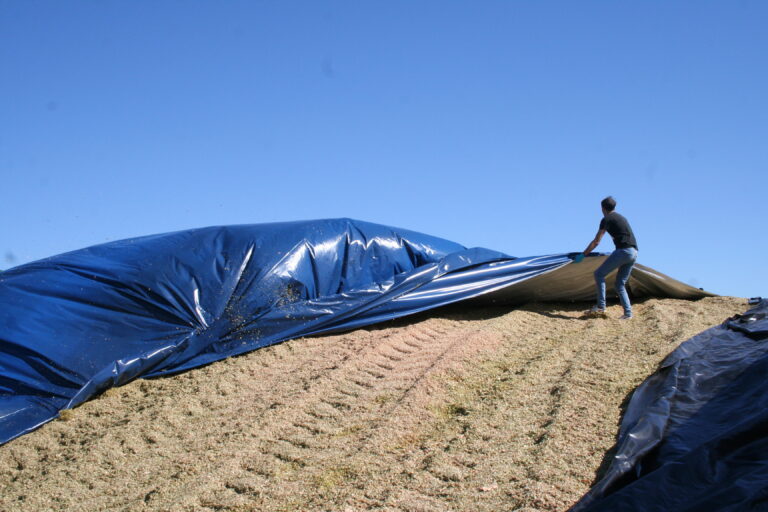
During the fermentation process of silage, nitrate is converted again. This is a standard process, and a certain formation of nitrous gases is unavoidable. In typical clamp silos, this often goes unnoticed, as the gases can escape slowly and are not further perceived. However, since silo gases are already produced during the filling and compaction of the silo, children should never play on silage heaps – it can be life-threatening.
Wait it out
If the release of such gases is noticed, the area around the silo should simply be avoided for some time. Fermentation gas hoods are not unusual and usually dissipate on their own over time. Even if they are not necessarily nitrous gases, they are still dangerous. In both cases, time usually resolves the issue: after a few days or weeks, the phenomenon should subside and the silage can be fed as normal.